

When business owners talk about mergers and acquisitions (M&A), they would always focus on price or valuation first. This is natural and understandable, as many business owners want to know how much their company is worth, what a fair selling price looks like, or how much they should pay to acquire another business. While valuation is certainly important, it is only one part of the overall picture in an M&A transaction. In reality, many successful transactions are not defined by price alone but by many other different factors, and deal structure is one of the important, yet often overlooked.
Imagine an M&A deal as if you are building a bridge to connect two buildings. The value of the deal may define the size of the project, but the deal structure determines how strong that bridge is, how it is built, and whether both sides can move forward safely and smoothly. Even if the price looks attractive at the start, a weak structure can lead to problems later on. When the structure is well-planned, it creates a stronger, steadier path for both buyer and seller to move forward with greater clarity and confidence.
This is why deal structuring matters so much in any M&A transaction. It influences how risk is shared, how payment is made, how control is transferred, how liabilities are handled, and how smoothly the businesses can work together after the deal. For SME business owners especially, understanding deal structure is important because the right approach can help protect value, reduce surprises, and support the long-term goals of both sides.
In this article, we will look at what deal structure means and explores the five common types of M&A deal structures that business owners should know before starting the conversation.
What Is a Deal Structure in M&A?
In simple terms, a deal structure is the blueprint of an M&A transaction, determining three key things:
1. What is being bought or sold?
2. What are the payment terms or arrangements of the deal?
3. How are responsibilities divided between the buyer and the seller?
In practice, these decisions shape how the deal structure actually works. For example, a buyer may want to acquire an entire company, including its brand, people, customers, suppliers, contracts, and operations. In other situations, the buyer may only want selected assets, such as machinery, customer contracts, property land, or intellectual property, while avoiding certain unwanted liabilities. Payment arrangements can also differ from deal to deal – sometimes paid fully in cash upfront, and in other cases split over time or linked to future performance. All these choices form part of the deal structure.
However, there is no universal structure that works for every transaction. Every business has its own history, financial condition, growth plans, and risk profile. Some business owners want a clean exit. Others want to remain involved for a few years. Similarly, some buyers may want full control from day one, whereas others prefer to start with a minority stake or a partnership arrangement. Therefore, choosing a deal structure is not just a legal exercise. It is a strategic decision that needs to match the objectives of the people involved.

Key Types of M&A Deal Structures
There are several common ways an M&A deal can be structured, and each one serves a different purpose depending on the goals of the buyer and seller. Some structures are designed for a full transfer of ownership, while others support partnerships, phased transitions, or risk-sharing arrangements. Knowing the differences can help business owners make more informed decisions and understand which approach fits their objectives and expectations.
1. Share Purchase
One of the most common structures in M&A is the share purchase, also known as an equity deal. In this arrangement, the buyer acquires the shares of the target company and takes over the business as a whole legal entity. This usually means the buyer inherits everything within the company, including its operations, contracts, licenses, assets, and liabilities.
A share purchase is often used when the buyer wants to acquire the business largely as it operates today, with minimal disruption to day‑to‑day operations. Because the legal entity remains unchanged, many existing contracts, customer relationships, and licences can often continue as part of the business, subject to their terms and any required consents. At the same time, taking over the entire company also means the buyer assumes responsibility for past obligations and risks that sit within the business. For this reason, thorough due diligence is essential to help both parties clearly understand what is being transferred as part of the deal.
2. Asset Purchase
In contrast, an asset purchase allows the buyer to be far more selective. Instead of acquiring the entire company, the buyer selects only specific assets or parts of the business to acquire, such as equipment, intellectual property, inventory, specific business units, or customer contracts.
This structure gives the buyer more flexibility, especially if they want to avoid taking on unwanted liabilities. Using the same analogy, this is like purchasing only certain parts of a car rather than the whole vehicle. This flexibility can be particularly valuable when dealing with distressed businesses or situations where risks need to be carefully managed. However, the trade-off can be complexed, as transferring individual assets, contracts, and employees often requires additional legal and operational steps, which can make the process more time-consuming.
3. Merger
Another common structure is a merger, where two companies combine to form a single entity. Unlike a straightforward acquisition, a merger typically involves integration on both sides. This structure is usually chosen when both businesses see long-term strategic value in coming together, whether to increase market presence, improve efficiency, or strengthen capabilities.
A merger can create a stronger combined business, especially when both companies bring complementary strengths, but it also requires more planning because the two organisations need to align on systems, leadership, operations, and culture. In many cases, the challenge is not just combining the businesses on paper but making sure they can function well together afterwards.
4. Joint Venture (JV)
A JV involves two or more parties creating a new business or entity together, with shared ownership and responsibility. Rather than one side acquiring the other, both parties contribute something of value, such as capital, resources, technology, local knowledge, or market access.
This structure can be useful when entering a new market or pursuing an opportunity that would be harder to achieve alone. The benefit of a JV is that risk is shared, but because control and decision-making is also shared, it is important to have clear governance and aligned expectations from the beginning.
5. Majority or Minority Investment
In some M&A transactions, the parties may agree on either a majority or minority investment, depending on the level of ownership, control, and involvement they are looking for after the deal.
A majority investment usually means the buyer acquires more than 50% of the company, allowing them to take a leading role in major decisions and the future direction of the business. For sellers, this can provide an opportunity to realise part of the value they have built while still remaining involved in the company, depending on the agreed arrangement. It is often used when both sides want a change in control, but not necessarily a complete exit from day one.
On the other hand, a minority investment involves the buyer taking less than a controlling stake. From the buyer’s side, this offers a way to enter the business, build a relationship, and participate in its future growth without taking full ownership immediately. From the seller’s side, it allows the existing owner to raise capital, bring in strategic support, or strengthen the business while still retaining overall control of day-to-day operations. Both majority and minority investments are commonly used when the focus is on partnership, phased transition, or long-term value creation, rather than an immediate full takeover.

How Deals Are Paid: Understanding Payment Terms
Beyond the overall deal structure, how an M&A transaction is paid is another key area to consider. This is an important part of the negotiation because payment terms can shape the level of risk, trust, and alignment between buyer and seller.
1. Cash Deal
The most straightforward option is a cash deal, where the buyer pays the agreed amount in full and the seller receives payment and liquidity immediately, usually at the completion stage. It is straightforward and easier to understand, which is why cash deals are often preferred when both sides want clarity and simplicity. However, not all buyers have the ability or desire to pay the full amount upfront, especially in larger or more complex transactions.
2. Stock-for-Stock Deal
In a stock-for-stock deal, the seller receives shares in the buyer’s company instead of or in addition to cash. This means the seller remains economically connected to the future performance of the combined business. In a way, it is like exchanging one boat for a place on a bigger boat. The seller gives up ownership of their original company but continues to participate in future growth. This structure is often used when there is a strong strategic fit, and both sides want to align long-term interests.
3. Earn-outs
Earn-outs are also common, especially when the buyer and seller have different views on value. Under an earn-out structure, part of the purchase price is paid later, depending on whether the business achieves agreed performance targets after the deal. This is often used when there is a gap between what the seller believes the business is worth and what the buyer is willing to pay upfront. You can think of it as paying in instalments based on results. This can help bridge valuation gaps, but it also requires clear and realistic targets. If the targets are unclear or if the seller no longer has enough influence over the business after the deal, disagreements can easily arise.
That said, many transactions today are adopting hybrid structures, meaning, combining elements of cash, shares, and earn-outs. That is because it allows both parties to balance risk and reward in a way that suits their respective positions. For example, a seller might receive some cash upfront for certainty, while retaining an upside through shares or performance-based payments.
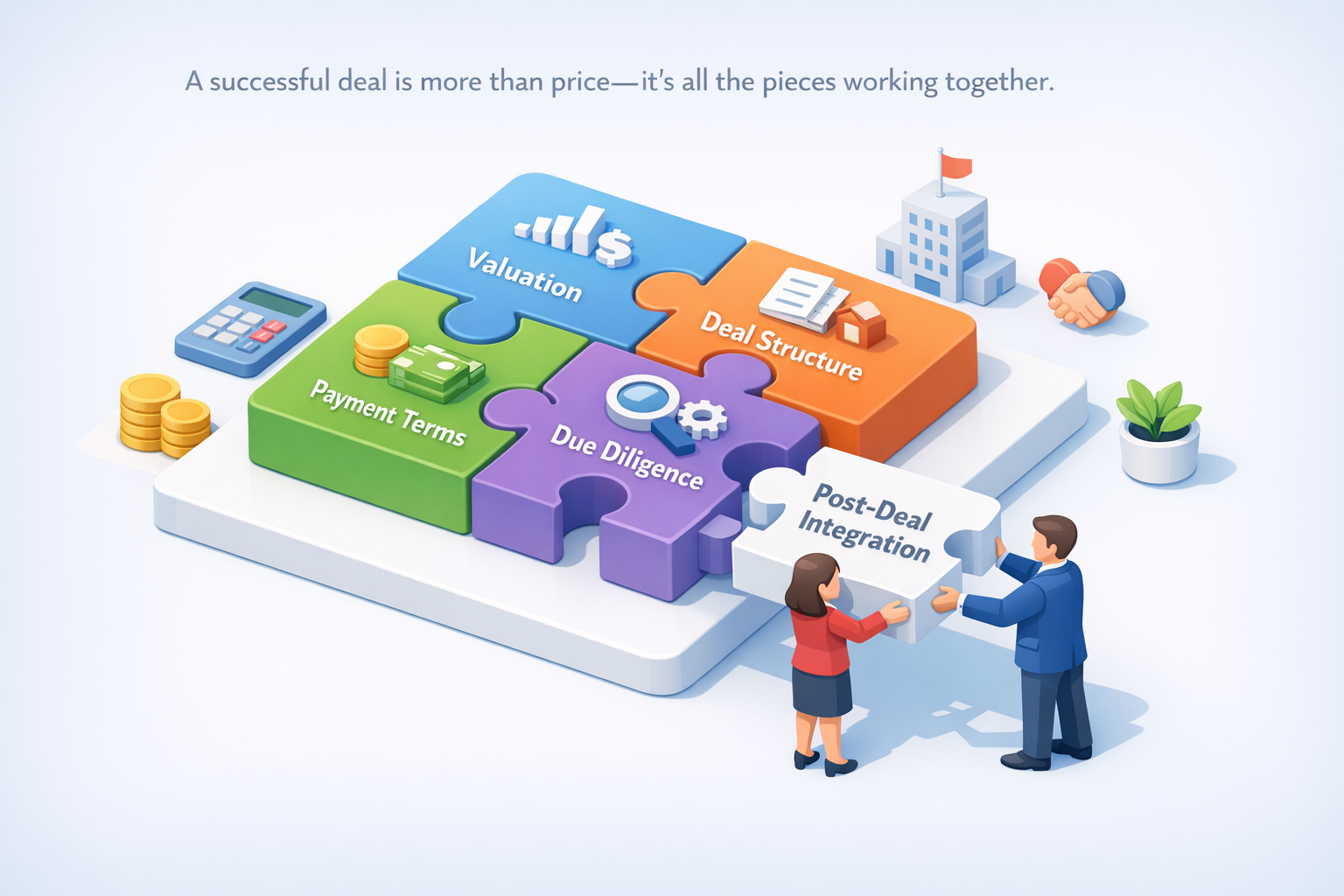
A successful M&A deal is not only about agreeing on a price. It is also about deciding what is being transferred, how the deal is paid, and how risks and responsibilities are shared between both sides. That is why deal structure plays such an important role in shaping the outcome of a transaction.
For business owners, understanding the common types of deal structures and payment terms is a useful starting point. It helps create better awareness of what each option means in practice and why the “right” structure will depend on the goals, priorities, and circumstances of the people involved. In many cases, the strongest deals are not simply the ones with the highest valuation, but the ones built on a well-planned structure that supports a smoother and more sustainable path forward.
Learn more about how the right deal structure can protect your business value, and speak with our M&A advisors at Nihon M&A Center Malaysia to find the approach that works for you.