
For many SME business owners in Malaysia, growth often follows a familiar formula. You build the business steadily, improve revenue year by year, expand your customer base, open new branches, enter new markets, and, if everything goes well, perhaps one day consider an initial public offerings (IPO).
For a long time, this has been viewed as the natural path of a successful company. To many entrepreneurs, getting listed on the stock exchange feels like the “end goal” – a sign to proof that the business has finally reached a new level of scale, credibility, and maturity.
At the same time, mergers and acquisitions (M&A) are still often viewed very differently. Many business owners see it as something only meant for large corporations, listed companies, or multinational groups. For SMEs, acquiring another company can seem too complex, too expensive, or simply “not for us.”
But that way of thinking may be causing many businesses to overlook an important opportunity.
Because M&A is not only something to consider after a business becomes large. In many cases, it can be one of the very tools that helps a business become larger, stronger, and more strategically positioned in the first place.
Seen this way, the conversation is no longer about choosing M&A or IPO as though one must come before the other. The more useful question may be how both can work together within the same long-term growth strategy.
For some companies, an IPO can provide the capital, visibility, and acquisition currency needed to pursue M&A more actively. For others, strategic acquisitions can strengthen the business first, helping it build scale, diversify earnings, and develop a more compelling story before exploring a future listing.
In other words, M&A and IPO do not have to be competing options. Very often, they are complementary tools that can strengthen one another.
Growth Today Is Becoming Harder to Build Organically
In the past, many businesses could grow steadily simply by doing more of what already worked. Open another outlet. Hire more people. Increase sales efforts. Expand into another city.
While organic growth still matters, the reality today is that scaling a business has become much more demanding, as competition is more intense, margins are tighter, talent is harder to attract and retain, customer expectations are evolving quickly, and many industries are changing much faster than before.
For many business owners, growing from RM20 million to RM100 million in revenue through purely organic can take years or sometimes even decades. And that brings up a question that probably worth asking: “Is building everything on your own really the only way to grow?”
In many cases, the answer is no.
Sometimes, growth can be accelerated not only by building, but by buying. Instead of spending years developing a new customer and supplier base, operational capability, or market presence internally, a business may be able to gain these through the right acquisition.
Of course, this does not mean replacing organic growth entirely. Rather, it means adding another growth engine to the business. Think of it this way, if organic growth is steadily progressing, then strategic M&A can help a business to accelerate that journey when the right opportunity arises.
That said, many business owners still assume that M&A is something to explore only after the company becomes bigger, more financially powerful, or even publicly listed.
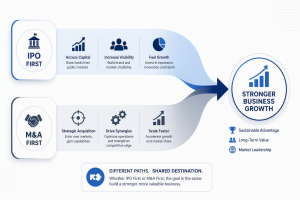
But here is another way to look at it. There are generally two strategic routes business owners can consider:
- Go public first, then use that stronger position to pursue M&A
- Pursue M&A first, then move towards IPO from a stronger foundation
Neither path is necessarily better than the other, because it depends on where the business stands today, what opportunities are available in the market, and what the owner ultimately wants to build.
Pathway One: IPO First, Then Use M&A to Accelerate Growth
For some businesses, going public first can create a powerful foundation for future acquisitions.
Traditionally, many business owners see an IPO mainly as a fundraising exercise or a liquidity milestone. Once listed, the business is expected to continue doing what it has always done, only at a larger scale and under greater public visibility.
But a public listing can also be viewed from another angle: not simply as an outcome of great success, but as a strategic step that creates more options for future expansion. This is where M&A becomes especially relevant.
Why an IPO Can Strengthens a Company’s Ability to Pursue M&A
- Better access to capital: Listed companies generally has more structured and scalable ways to raise funds. Whether through equity fundraising, debt instruments, or other capital market channels, being listed can create greater financial flexibility to act on acquisition opportunities when they arise. This matters because in M&A, timing is often important. A business may identify a strong target, but without sufficient access to capital, even the right opportunity may be difficult to pursue.
- Stronger market credibility: A listed company also tends to carry greater credibility in the eyes of customers, banks, partners, and potential acquisition targets. The governance, transparency, and disclosure standards associated with a public listing can create a stronger sense of trust. This can make a real difference in an acquisition process. If you are a business owner considering selling your company, you may naturally feel more comfortable dealing with a buyer that has clearer governance, stronger visibility, and a more established market profile. In that sense, an IPO can strengthen not only the buyer’s financial position, but also its attractiveness as an acquirer.
- Greater flexibility in deal structuring: One of the more important advantages of being listed is the potential ability to use shares as part of the acquisition consideration. This gives companies more flexibility in how they structure deals. Rather than relying entirely on cash, they may be able to offer a mix of cash and shares, particularly in situations where the seller is open to remaining involved in the next stage of growth. That flexibility can be valuable in many scenarios, especially when the seller wants to stay invested in the future upside of the combined business.
How M&A Can Support Growth After IPO
Once listed, a company may use M&A in several ways, depending on its strategy:
• Acquire a competitor to increase market share and strengthen its position in the industry
• Acquire a supplier or distributor to improve control across the value chain
• Acquire a complementary business to broaden its offerings and cross-sell to existing customers
• Acquire a business with new capabilities or technology to accelerate transformation and stay competitive
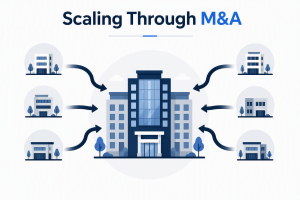
The key takeaway is that instead of waiting years to build every capability internally, M&A can meaningfully shorten the growth timeline and allow the company to move more decisively. This becomes particularly relevant in fragmented industries, where many smaller players operate side by side and no single company holds a dominant position. In such environments, companies that use acquisitions well can often build scale faster than those relying on organic expansion alone.
So in this pathway, IPO is not the main story by itself. Its value lies in how it can support the next phase of strategic growth, and very often, the next phase is driven by M&A.
Pathway Two: M&A First, Then Approach IPO from a Stronger Position
Now let’s look at the other route. For many SMEs, this may actually be the more practical and relevant strategy to consider.
Not every business that aspires to go public is ready to do so today. A company may be profitable, but still too small to attract strong investor interest. It may have too much concentration in one customer, one product line, or one market. Or it may simply not yet have a compelling enough growth story for the public market.
When faced with these gaps, many business owners respond the same way – they wait. They assume the answer is to continue growing organically for another three, five, or even ten years before revisiting the idea of IPO.
But what if there is another way to strengthen the business faster? That is where M&A comes in.
Instead of waiting for scale, diversification, or market presence to develop slowly over time, a business may be able to build these qualities through carefully selected acquisitions.
How M&A Can Strengthen IPO Readiness
- Building scale faster: Larger businesses tend to attract more investor attention. Through M&A, a company may be able to increase revenue, expand operations, and strengthen its market footprint far more quickly than through organic growth alone. For example, a manufacturing company with strong products but limited market reach may choose to acquire an established distributor rather than spend years building its own distribution network.
- Reducing concentration risk: A business that depends heavily on one customer, one sector, or one revenue stream may be seen as carrying higher risk. Acquiring complementary businesses can help broaden the earnings base and create a more balanced profile. This is often important not only for IPO readiness, but for the overall resilience of the business.
- Strengthening market position: A stronger market position often leads to a stronger equity story. A company that has expanded through acquisition may be able to show that it is not just growing but also consolidating its role within the industry. That can make a meaningful difference when investors compare it with peers.
- Creating a stronger growth narrative: Investors do not only look at historical performance. They also look at the quality of the company’s future growth story. A business that can show it has successfully identified, executed, and integrated acquisitions may present a more convincing case than one still describing growth plans only in aspirational terms.
In many ways, M&A can help shape a stronger “IPO story,” not by improving the narrative alone, but by changing the underlying business reality.
Instead of saying, “We hope to become a stronger player in this sector one day,” the company may already be able to say: “We have expanded our capabilities, diversified our revenue base, and strengthened our market position through acquisition.”
That difference matters. And this is why, for some businesses, the fastest route to IPO readiness is not simply waiting to grow. It may be using M&A strategically to become a stronger company first.

So, Which Should Come First?
There is no single formula that applies to every business. Some companies may already have the profitability, governance standards, and scale required for a public listing. In those cases, listing first may create the capital strength and market standing needed to pursue M&A more confidently afterward. Others may be in a different position. They may see clear acquisition opportunities in the market but may not yet be large or diversified enough to achieve the kind of IPO outcome they want. For such businesses, M&A first may be the more effective route.
The real decision usually comes down to a few practical considerations:
• How strong is the company’s current financial position?
• Does the business already have the scale and track record required for a listing?
• Is capital currently accessible through internal reserves, financing, or investors?
• Are there attractive acquisition opportunities available now?
• And most importantly, what is the long-term growth ambition of the business?
These are not just financing questions. They are strategic questions. Because in the end, the issue is not whether IPO comes first or M&A comes first. The more important issue is whether the business is making full use of the strategic options available to strengthen its position for the next stage of growth.
Why This Matters More for Malaysian SMEs Today
For many Malaysian SMEs, M&A still feels like something distant, it feels like a tool just for larger players, not for mid-sized owner-managed businesses. But that perception is gradually becoming outdated.
Across many sectors, business owners are facing rising competition, succession issues, margin pressure, and increasing demands for capability, scale, and speed. In that environment, relying on organic growth alone may not always be enough.
M&A offers another way forward. It can help a business enter a new market faster, gain customers more quickly, add capabilities that would otherwise take years to develop, reduce dependency on a single revenue stream, or strengthen its position in a fragmented industry.
That is why M&A should not be seen only as a corporate finance event. It is increasingly a strategic tool for business building. And from that perspective, IPO becomes one possible chapter in the journey – not always the starting point, and not always the end goal.
For some businesses, M&A may lead naturally to a future IPO. For others, M&A may continue to be the primary engine of growth without any immediate need to go public. Both paths are valid. What matters is whether business owners are thinking broadly enough about how to build the next stage of the company.
Too often, the question is framed as: “Should we focus on IPO or on M&A?”
But a more useful question may be: “How can M&A strengthen our business today and what future options could that create, including IPO?”
That shift in thinking matters. Because for many SMEs, M&A is not something to consider only after they become bigger. Very often, it is one of the ways they become bigger. At the same time, M&A is not only relevant during the growth phase. For some business owners, it also becomes part of the eventual transition, whether it is for succession planning, retirement, or full exit – ensuring the business they have built continue to grow under new ownership, while also unlocking the value they have created over the years. If you are interested in understanding this perspective further, you can read more about what business succession truly means and why M&A can be a strategic exit option for SMEs.
Curious how M&A fits into your growth plans? Contact us today to explore what is possible for your business.