
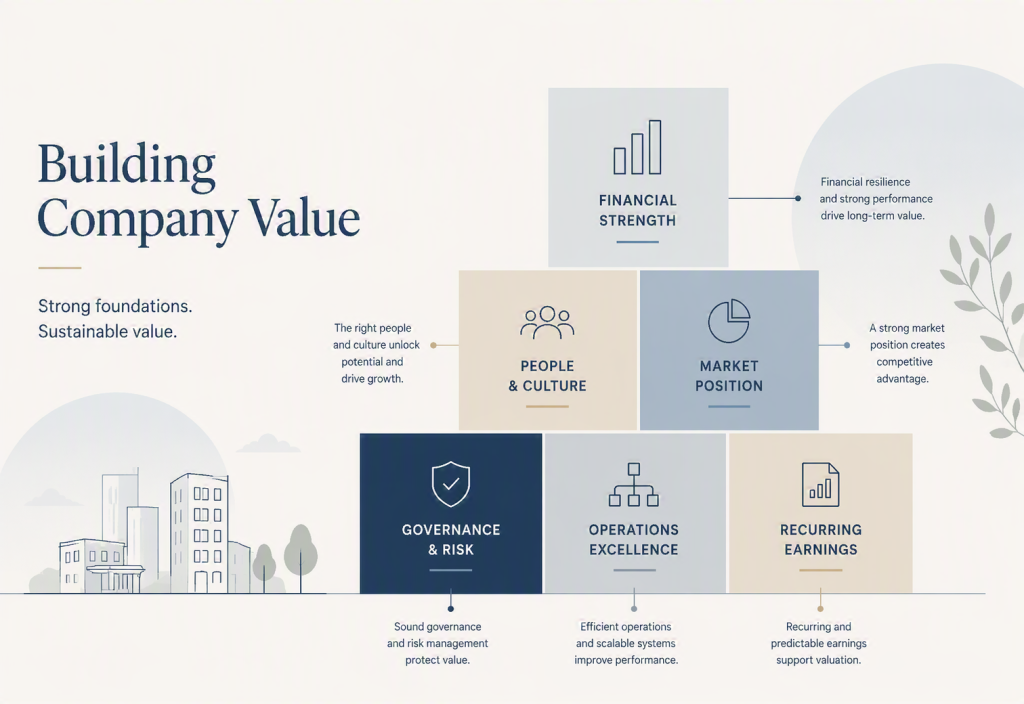
Ask any SME business owner what their company is worth, and chances are they already have a number in mind. Some base it on years of effort building the business. Others look at revenue, assets, or comparable companies in the market.
After all, when you have spent years, or even decades, growing a company from the ground up, it is only natural to attach significant value to what you have built.
However, a company’s worth is not determined only these factors alone. In many cases, what a business owner believes their company is worth can be quite different from how investors, buyers, lenders, or strategic partners assess it.
This gap in perception matters, especially when it comes to making important decisions for your next move.
For example, a business owner may value their company at RM20 million based on its revenue, while an external party may focus more on profitability, customer concentration, management strength, scalability, and long-term growth potential. At the same time, a smaller business may command a stronger valuation if it demonstrates resilience, consistency, and the ability to grow sustainably.
This is why having a clear understanding of your company’s true value matters.
It is not just about preparing for a potential transaction. It is about gaining clarity on what truly drives your business, identifying areas that may be limiting its potential, and making more informed strategic decisions as you plan your next phase of growth.
Whether your goal is to expand into new markets, attract investment, strengthen your competitive position, plan for succession, or simply build a stronger business, having a clear sense of your company’s value provides a useful benchmark for where your business stands today and where you can aim for next.
What Exactly Is Company Value?
At its simplest, company value refers to the estimated worth of a business at a given point in time. It represents how attractive and valuable the business is based on its current performance, underlying fundamentals, and future potential.
Many SME owners assume that value is driven purely by revenue or profit. While financial performance certainly plays an important role, valuation is rarely that straightforward.
Think of it like purchasing a property. Two houses may have the same size and similar construction costs, but one may be worth significantly more because of its location, condition, surrounding developments, and long-term potential.
The same principle applies to businesses.
Beyond the numbers, value is also shaped by a range of qualitative and structural factors such as how predictable your earnings are, how diversified your customer and supplier base is, whether your business can operate beyond the founder, and how defensible your position is within the industry. A company that demonstrates consistent performance and can operate independently of its founder will often be viewed more favourably than one that depends heavily on a single customer or the day-to-day involvement of the owner.
In other words, company value reflects not only where a business is today, but also how confidently others can envision its future trajectory.
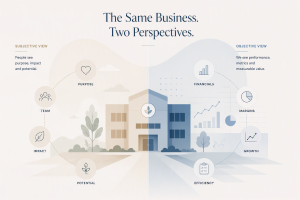
Why Understanding Company Value Matters
Many SME owners tend to associate company value with specific events like fundraising, succession planning, or selling the business. While it is certainly important in these situations, its relevance and significance extend far beyond any single event.
Understanding your company’s value provides a clearer and more complete picture of the overall health of your business. It serves as a benchmark that reflects not just current performance, but also the company’s ability to sustain growth, navigate challenges, and capture future opportunities.
When value strengthens over time, it often signals that the business is becoming more efficient, more resilient, and better positioned for long-term success. It also plays an important role in shaping better decision-making.
Throughout any business journey, owners are constantly making choices, whether it is expanding into a new market, investing in systems, hiring key talent, or pursuing new growth opportunities. By understanding what drives value, these decisions can be made with greater intention, ensuring they contribute not only to short-term performances but also to longer-term business strength. And most importantly, it encourages a shift in mindset – from focusing purely on revenue generation to building a business that is sustainable, scalable, and capable of thriving well into the future.
What Drives Company Value?
While every business is unique, there are several common factors that influence how a company is valued. Understanding these drivers can help business owners identify areas of strength, highlight potential risks, and discover opportunities to build a more resilient and attractive business over time.
1. Company Size (Scale of the Business): One important but often overlooked factor is company size. In many markets, larger businesses tend to command higher valuation multiples compared to smaller ones, as scale often brings greater stability, stronger market presence, and more diversified operations, all of which support long-term growth. In practice, this means that even within the same industry, companies may be valued differently simply based on their size. Businesses operating at a larger scale often benefit from stronger positioning and pricing power, which in turn influences how their value is assessed. For SME owners, this is not a limitation, but a clear direction that growth in scale is not just about increasing revenue, but about strengthening the overall profile and resilience of the business over time.
2. Financial Performance: Strong and consistent financial performance remains a key valuation driver. Businesses with healthy revenue growth, sustainable profitability, and reliable cash flow are generally better positioned for long-term success. However, it is not just about size, it is also about the quality of revenue. Recurring income, such as long-term contracts or repeat customers, creates greater stability and visibility. Profit margins also play an important role. Strong margins often indicate pricing strength or operational efficiency, while weaker margins may highlight cost pressures or competitive challenges.
3. Customer and Supplier Diversification: Businesses that rely heavily on a single customer or a small group of clients often face higher levels of risk. The loss of a key customer can significantly impact revenue, while concentrated relationships may limit negotiating leverage. Similarly, reliance on a major supplier can create vulnerabilities, especially if that supplier is able to dictate unfavourable terms. Therefore, building a diversified customer and supplier base strengthens stability and reduces dependency, allowing the business to operate more consistently over time.
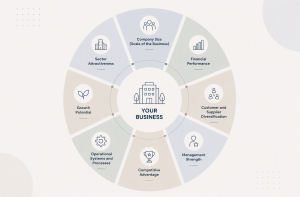
4. Management Strength: A business that can operate effectively beyond its founder is generally seen as more stable and scalable. Developing a capable second-line management team reduces reliance on the owner for day-to-day operations and allows the business to run more independently. Clear structures, defined responsibilities, and succession planning also support continuity and strengthen the long-term sustainability of the business.
5. Competitive Advantage: Companies that possess unique strengths tend to command higher valuations because they are more difficult for competitors to replicate. These advantages may take several forms, including:
• Proprietary technology or intellectual property
• Exclusive supplier or customer contracts
• Strong brand recognition and market presence
• Regulatory licenses, certifications, or approvals
• Specialised expertise or long-standing customer/supplier relationships
Together, these factors help the business maintain its position in the market and create a foundation for sustained performance.
6. Operational Systems and Processes: Well-structured operations play an important role in supporting both stability and growth. Businesses with clearly documented processes, disciplined governance practices, and efficient systems are better positioned to scale without relying heavily on specific individuals. When knowledge and decision-making are embedded within the organisation, the business becomes easier to manage, adapt, and grow over time. This level of operational maturity signals that growth can be managed in a controlled and sustainable way.
7. Growth Potential and Sector Attractiveness: Future potential is just as important as current performance. Businesses operating in industries with consistent growth, innovation, or supportive trends are naturally better positioned for expansion. At the same time, companies with clear growth pathways, whether through new markets, products, or capabilities, are more likely to sustain momentum over the long term. Ultimately, both the environment the business operates in and its ability to grow within it shape its future trajectory.
If you are interested in exploring this further, we have also covered some of the common misconceptions SME owners often have about company valuation in one of our recent articles.
Strong Company Value Creates More Strategic Options
Building value is not simply about aiming for a higher number. More importantly, it creates optionality.
A business with strong fundamentals, stable profitability, diversified customers, capable management, and clear growth potential is naturally in a better position to explore a wide range of strategic paths. This may include expanding into new markets, attracting investors, securing financing, planning for leadership succession, forming strategic partnerships, or exploring mergers and acquisitions (M&A).
In many ways, company value is as a reflection of how attractive and resilient a business has become. The stronger the business, the more opportunities it is likely to attract.
This is particularly relevant when it comes to M&A.
Many business owners associate M&A primarily with exits, which can lead to the misconception that valuation only becomes important when preparing to sell. In reality, the most successful M&A outcomes are often built well before any transaction discussions begin.
Strategic buyers or investors are not simply just looking for businesses that are available for sale. They are looking for businesses that are well-built. Companies with strong fundamentals, capable teams, stable customer bases, and clear growth potential tend to attract more serious interest. As a result, businesses that have invested time in strengthening their value are often able to negotiate from a position of strength and gain access to a broader pool of potential partners.
For this reason, value creation should not be treated as a one-time exercise conducted before a transaction. Instead, it should be seen as an ongoing effort to building a stronger, more future-ready business.
At Nihon M&A Center Malaysia, we often share this perspective with SME owners that building value should start long before any transaction is on the table. Rather than focusing only on preparing for a deal, the emphasis is on strengthening the underlying business over time. By doing so, companies naturally create more opportunities for growth, succession, partnerships, and long-term success, regardless of whether a transaction eventually takes place.
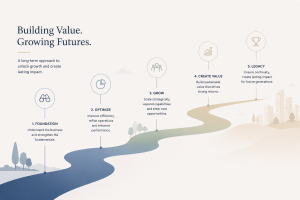
Company Value Is Built Long Before Any Transaction
There is no single moment that suddenly transforms an ordinary business into a highly valuable one.
Rather, company value is built gradually through consistent effort in strengthening operations, improving profitability, developing management capabilities, diversifying revenue streams, and creating sustainable growth over time.
Whether your current focus may be expansion, succession planning, attracting investment, or strengthening your market competitive position, understanding your company’s value can help you make more informed and intentional decisions.
Ultimately, company value is more than just a number. It is a reflection of the business you have built and the opportunities it can create in the future. And the sooner you begin understanding it, the better positioned you will be to realise its full potential.
Curious what your business is really worth? Get in touch with us to gain a clearer understanding of your company’s value and how it can shape your next move.