
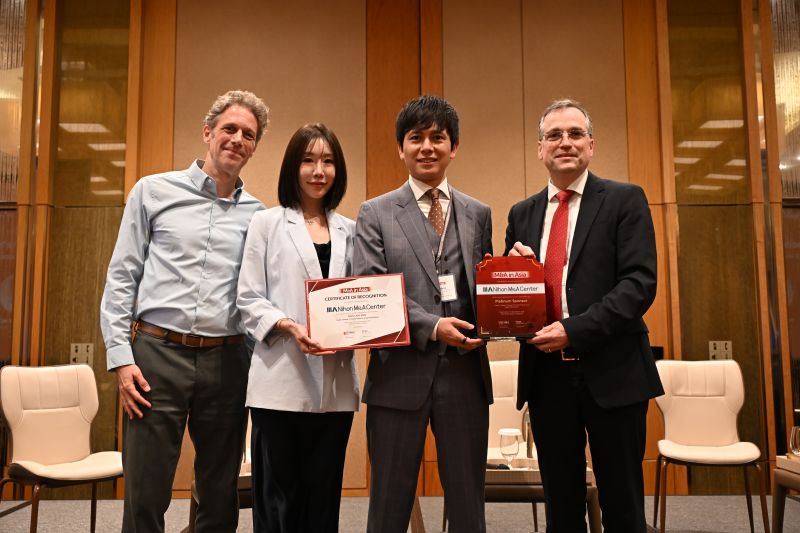
Across Asia, the M&A landscape continues to evolve. Companies are looking at M&A for different reasons, from entering new markets and strengthening regional capabilities to business succession, strategic partnerships and long-term value creation. As deal activity becomes increasingly cross-border, understanding these different motivations and market dynamics is becoming an important part of navigating opportunities across the region.
These broader industry conversations came together at the M&A in Asia Conference 2026, held on 10 November 2026 in Singapore and organised by the Institute for Mergers, Acquisitions and Alliances (IMAA) and the Mergers and Acquisitions Association of Singapore. The conference brought together more than 300 participants from across the globe, including business leaders, investors, advisers and M&A professionals to exchange perspectives on the trends, opportunities and challenges shaping the wider Asian M&A landscape.
Representing Nihon M&A Center, Mr. Yusuke Ojima, Corporate Officer and Head of Overseas Division, and Mr. Ryosuke Sakamoto (Rio) of Nihon M&A Center Malaysia contributed a Japanese perspective to these wider discussions. Their sessions explored the growing intersection between Japan and Southeast Asia, from how evolving succession needs can create new possibilities for business owners to what Japanese corporates consider when pursuing M&A opportunities across ASEAN.
Where Succession and Expansion Come Together
One of the key discussions, “Succession Meets Expansion: The Next Japan-Southeast Asia M&A Corridor,” brought together Mr. Yusuke with A/Prof Yupana Wiwattanakantang from NUS Business School, whose research focuses on family businesses and succession, alongside moderator Mr. Lee Swee Siong, Managing Director at TrueVA Capital and the Advisory Council Chair for Association of Small & Medium Enterprises (ASME) SME Unite Programme. The panel explored how evolving succession needs among family businesses could intersect with the growing interest from Japanese companies looking for opportunities in Southeast Asia.
Across the region, business succession is becoming an increasingly important consideration for founder-led and family-owned businesses. Traditionally, many founders have built their companies with the expectation that ownership and leadership would eventually be passed down to the next generation, allowing the family to continue the business and preserve what has been built over the years.
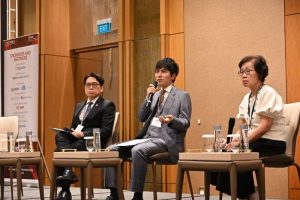
Drawing from her research studies, A/Prof Yupana shared how this traditional approach to succession is gradually evolving. While keeping the business within the family remains important to many owners, the next generation may have different aspirations or may face the challenge of taking an established business into its next stage of growth.
This means succession no longer has to follow only one path. Business owners can also consider bringing in an external strategic partner to grow alongside the family, with M&A providing a pathway for the next generation to remain involved while gaining access to new expertise, capital, technology, networks or markets.
This becomes particularly relevant as Japanese companies increasingly look toward Southeast Asia for growth opportunities. Partnering with an established local business can provide Japanese corporates with local capabilities and a stronger foundation for regional expansion, while giving family businesses access to capabilities and networks that can complement their existing strengths. This naturally creates a two-way opportunity between succession and expansion.
Drawing from both his experience advising business owners and his personal experience of selling his own family business, Mr. Yusuke shared that bringing in an external partner should not necessarily be viewed as giving up what an entrepreneur has built. With the right partner and shared objectives, M&A can instead help preserve the strengths and legacy of the business while opening new possibilities for its future growth.
Ultimately, succession is not simply about who takes over. It is about finding the right structure and partnership for the company’s next chapter. In this sense, the succession needs of Southeast Asian businesses, and the growth ambitions of Japanese companies can complement one another, creating opportunities for continuity and growth on both sides.
From Japanese Interest in ASEAN to Successful Cross-Border Deals
The conversation continued in Mr. Rio’s panel, “Strategic Playbooks: Scaling Corporate M&A and Integration in ASEAN,” which explored how strategic corporate buyers are approaching M&A across the region and the practical considerations involved in executing and integrating cross-border transactions. The conversation was also joined by Mr. Justin Rebano, Principal of JRRITC, Mr. Franck da Silva, Founder & Managing Partner of Ænon, and Mr. Bhavesh Shukla, Managing Director of Knovos Singapore, moderated by Ms. Lam Shiao Ning, Managing Director of Rubicon Law LLC.

Speaking from the perspective of Japanese corporates, Rio shared why Japanese investment into ASEAN is growing and how SMEs in the region are responding to these opportunities. With Japanese companies increasingly looking beyond their domestic market for new avenues of growth, ASEAN offers opportunities to enter new markets, build local capabilities and strengthen their regional presence.
Beyond the growing interest, Rio focused on what Japanese companies actually prioritise when evaluating an investment. This ranges from what makes a business an attractive partner to potential “deal-breakers” that can make a cross-border transaction harder to move forward. Valuation expectations, communication, decision-making processes and alignment on the future direction of the business can all influence how a deal progresses.
For Japanese corporates, the considerations may extend beyond financial performance to how the business fits within their longer-term regional strategy. For ASEAN business owners, priorities may include what the partnership means for their employees, management team, customers and the future of the company.
Understanding these expectations early can make a meaningful difference. It allows both buyers and sellers to prepare more effectively, address potential gaps earlier and approach discussions with clearer expectations, creating a stronger foundation for a successful cross-border transaction.
Moving from Industry Discussion to Practical Exchange
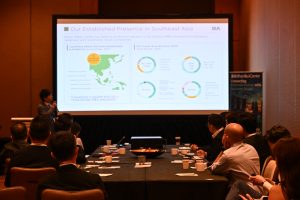
Following the conference discussions, Nihon M&A Center hosted an exclusive closed-door roundtable, welcoming over 30 business owners, investors and professionals who were keen to continue the conversation in a smaller and more interactive setting.
Rather than a one-way presentation, the session opened the floor for participants to share their questions, observations and challenges. The discussion went deeper into the Japan–Southeast Asia M&A landscape, including the macroeconomic environment shaping cross-border activity, common deal structures and how a typical cross-border M&A transaction progresses from initial discussions through to completion.
The roundtable also explored how different players across the M&A ecosystem can work together. With professional firms among the participants, the conversation touched on how Nihon M&A Center collaborates with industry partners across the region, while opening up discussions around potential opportunities to support cross-border transactions together.
Overall, the closed-door format provided a valuable opportunity to move beyond the broader themes discussed on stage and into a more practical exchange, helping participants gain a clearer understanding of how cross-border M&A works in practice and the different roles involved in bringing a transaction together.
Leading a Stronger and a More Connected M&A Ecosystem Across Asia
Across the different discussions, one message we consistently focused on was the importance of building a strong and connected M&A ecosystem across Asia. Successful cross-border M&A goes beyond connecting buyers and sellers. It also requires advisers, professional partners and other stakeholders to work together to bridge markets, align expectations and support businesses throughout the transaction.
At Nihon M&A Center, we aim to play a leading role in building these connections, drawing on our experience in Japan and growing presence across Southeast Asia to make cross-border M&A more accessible and smoother for business owners and companies exploring opportunities beyond their home markets.
Our participation in the M&A in Asia Conference 2026 was therefore not only an opportunity to share our experience, but also to strengthen relationships across the M&A community and explore how we can work more closely with partners across the region.
As more Asian companies consider M&A as part of their plans for growth, succession and business continuity, we believe stronger connections between markets will be essential in creating more successful cross-border opportunities.
For business owners, the right transaction can provide a path for what they have built to continue developing. For buyers, it can provide access to capabilities, people and markets that support their long-term strategy. When these interests align, cross-border M&A can become more than a transfer of ownership. It can create the foundation for the company’s next stage of growth.