
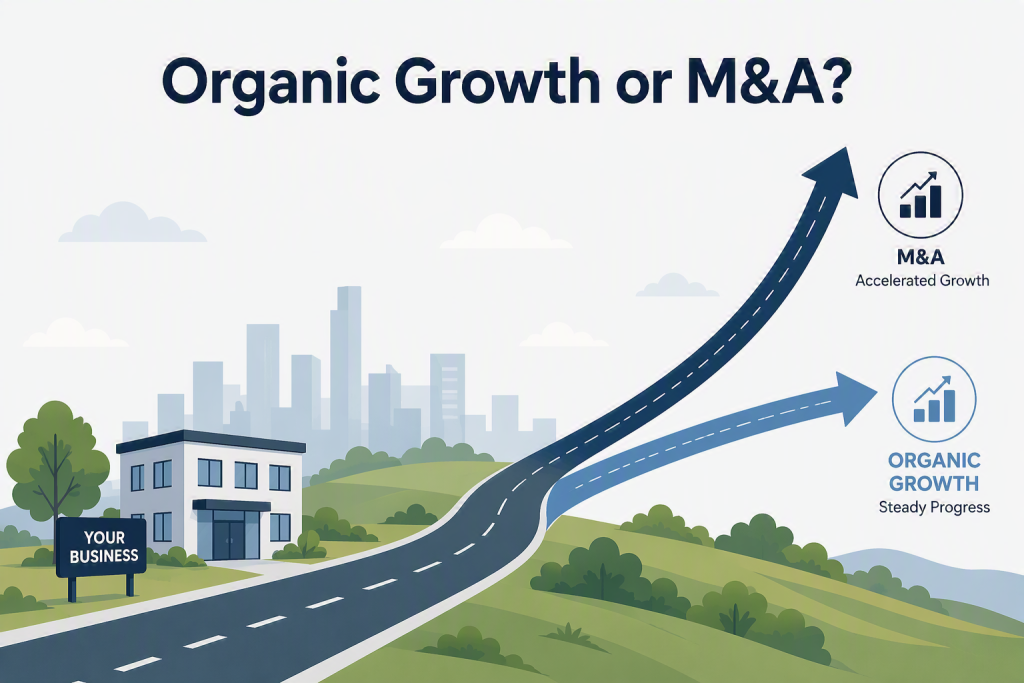
For many SME business owners, growth often starts in the same way – one customer at a time. You hire more people as demand increases, expand your offerings, strengthen operations, and gradually build the business over the years. This is the path most entrepreneurs are familiar with, and for many, it has worked well.
But growing a business today is not quite as straightforward as it used to be. Operating costs are rising, competition is becoming more intense, and finding the right talent is harder than ever. In many cases, growth may start to feel slower or stagnant despite continued effort and investment.
At some point, many business owners begin asking themselves this:
“Do we continue growing the way we always have or is there a faster way to scale?”
Increasingly, some SMEs are beginning to explore a different approach: growth through Mergers and Acquisitions (M&A). Rather than building everything from scratch, businesses are considering whether buying another company could help them grow faster, strengthen capabilities, or gain a competitive edge.
But does that mean M&A is always better than organic growth? Not necessarily.
The better question is: “Which strategy makes more sense for your business at this stage?”
Why Organic Growth Still Matters
For most SMEs, organic growth will always be the starting point.
Organic growth simply means growing your business through internal efforts, including increasing sales, getting new customers, improving operations, launching new products, or expanding your team over time.
You remain in full control, growth happens at a manageable pace, risks are generally lower, and decisions are based on what you already know best for your own business.
And for SMEs that are still strengthening their operations or refining their business model, growing organically often makes the most sense. If there are still opportunities to improve profitability, expand your customer base, or streamline processes internally, focusing on strengthening the foundation can create more sustainable long-term growth.
But while organic growth works well in the earlier stages of a business, it may not always be enough to get you to the next stage.
Why Some Malaysian SMEs Are Turning to Acquisitions
Many SMEs eventually reach a point where growth becomes harder. Your business may still be moving forward, but progress feels slower than before.
Perhaps sales are stable, but expansion is not coming as easily as it used to. Maybe competition is increasing, margins are tighter, or your industry has become more crowded. In some cases, you know there is opportunity in the market, but building internally feels too slow or resource intensive.
For Malaysian SMEs specifically, these challenges are often compounded by structural realities such as cash flow pressures from extended payment terms, difficulty accessing financing, and rising operational costs that make scaling feel heavier than it should.
When people think about M&A, most of the time they would imagine large corporations making billion-ringgit deals. However, in reality, M&A is becoming increasingly relevant for SMEs as well, driven by factors such as industry consolidation, growing cross-border opportunities, the rise of digital transformation, and a wave of business owners approaching retirement without a clear succession plan. These shifts are creating both the need and the opportunity for SMEs to think about acquisitions more seriously.
And if you have been following recent headlines, you may have noticed that a meaningful portion of Malaysia’s M&A activity is now taking place in the mid-market where recent transactions involving IT services providers, logistics operators, precision engineering firms, and education providers. These are not mega-conglomerates. Many of them are businesses that look a lot like yours.
A business acquisition does not always mean buying a massive company. Sometimes, it involves acquiring a smaller competitor, a complementary business, or a company with capabilities your business currently lacks.
Here is where it becomes more tangible.
1. Entering a new market
Expanding into new geographies, whether from Kuala Lumpur into Penang, from West Malaysia into East Malaysia, or from Malaysia into neighbour countries across ASEAN, takes a lot of time when done organically from ground up. You need to build local networks, understand regulatory requirements, hire on the ground, and establish credibility – all before generating a single ringgit of revenue.
An M&A shortens that timeline dramatically. Instead of starting from zero, you step into an existing operation with local knowledge, strong client and supplier relationships, and an established team.
For Malaysian SMEs looking to grow beyond domestic borders, this is becoming an increasingly important consideration, especially as the broader nation economic agenda continues to push for stronger, more competitive Malaysian businesses across the region. For many, acquiring an established presence in a new market may be a more realistic path to getting there than building one from scratch.
2. Closing capability gaps
Sometimes, the fastest way to gain a new capability is not to build it, but to buy it.
This is particularly true when it comes to technology, specialised expertise, or regulatory licences that take years to develop internally. A manufacturing company, for example, may consider acquiring a supplier to strengthen its supply chain and improve operational efficiency. A services business may acquire another firm that has already built the specialised know-how, proprietary systems, or technical certifications that would take years to develop in-house. In some cases, it could even be something as specific as acquiring a company that holds a licence, an accreditation, or an established relationship with a key client that cannot simply be hired for or fast-tracked.
For SMEs that recognise a gap but lack the time or talent to close it organically, acquiring a business with the right capabilities can be transformational.
3. Responding to a competitive shift
In some industries, the competitive landscape is shifting through consolidation. If your competitors are acquiring to gain scale in procurement, distribution, or technology, waiting on the sidelines may mean falling behind.
This is something that can happen gradually, and then all at once. One competitor acquires a smaller player. Then another does the same. Before long, the market has fewer but larger players, and the businesses that did not move are now competing against companies with broader reach, stronger supplier terms, and deeper resources. What used to be a level playing field starts to tilt.
Building 10 new locations from scratch could take years. Acquiring a competitor with those locations already operating gives you immediate reach and operational capacity. In industries like logistics, specialised manufacturing, food and beverage, and professional services, this kind of consolidation is already happening in Malaysia, and for SMEs in these spaces, staying aware of how the landscape is shifting is just as important as focusing on internal growth.
4. Bridging the succession gap
Malaysia’s family business landscape adds another dimension to this conversation. A significant majority of family-owned firms do not survive into the second generation, and many still lack a formal succession plan. This means that over the coming years, a growing number of well-established businesses will be looking for new owners.
And these are often good businesses. Many of them have been operating profitably for decades, built on strong customer relationships, trusted reputations, and deep industry knowledge. They may have a loyal customer base, reliable cash flows, and a proven operating model which are often the kind of foundation that is difficult to replicate from scratch.
This creates a dual opportunity. For business owners approaching retirement without a clear successor, selling to a strategic buyer can ensure their legacy continues. And for growth-minded SMEs with capital to deploy, acquiring one of these businesses can be a highly efficient way to grow.
In many cases, M&A is not about how big the deal is – they are about how well it fits. The right acquisition at the right time can give a business the speed, capability, or market access that would have taken years to build alone. And that is often when the mindset begins to shift, from “How do we build this ourselves?” to “Does it make more sense to acquire something that already exists?”

But M&A Is Not a Shortcut to Easy Growth
While acquisition-led growth can be powerful, it is important to recognise that it also comes with certain challenges.
Buying a business is rarely as simple as signing an agreement and immediately seeing results.
Every company comes with its own people, culture, systems, and operational realities. Even businesses that appear attractive on paper may face hidden issues beneath the surface.
Some common challenges include:
• overpaying for a business,
• customer retention risks,
• key employee departures,
• operational integration difficulties, or
• cultural misalignment between both businesses.
Of course, these are not the reasons to avoid M&A, but to approach them more thoughtfully.
This is why successful acquisitions usually begin long before a deal takes place. The strongest buyers are not the ones who move the fastest. They are the ones who take the time to get clear on what they are looking for and why. They ask the fundamental questions early: “Why are we acquiring this business? Is it to grow market share? Strengthen capabilities? Improve efficiency? Access talent? Enter a new market?”
When the rationale is clear, every decision that follows, from identifying the right target, to negotiating the right terms and value, to planning for integration, becomes significantly easier. But without that clarity, M&A can become distractions rather than growth opportunities, consuming time, capital, and management attention without delivering the results the business set out to achieve.
It is also worth remembering that not every business is ready for M&A. A Kuala Lumpur-based SaaS startup that has been operating for 18 months, for example, may find that the product is gaining traction, but the team is still refining it based on customer feedback. For a company like this, approaching M&A might be a bit too early. The business model is not yet fully proven, and taking on the complexity of an acquisition could divert focus and resources away from what matters most at this stage. The priority is to deepen its understanding of customer needs, refine its product, and build a sustainable revenue engine. At this point, growing through organic efforts or potentially with the support of venture capital or private equity investors is the more practical path forward.
The Best Growth Strategy May Not Be One or the Other
The reality is that growth does not always have to be a choice between organic expansion and M&A. In fact, many successful SMEs eventually use both.
Organic growth helps strengthen the core business like improving operations, building customer relationships, and creating stability. M&A, meanwhile, can become strategic tools to accelerate growth when the business is ready.
The key is understanding timing. It starts with thinking about what you want the future of your business to look like – where you want to be in three, five, or ten years – and then working backwards to figure out the most realistic way to get there.
In Malaysia’s current environment with steady GDP growth, increasing cross-border investor interest, and policy support through national development frameworks, the conditions for strategic M&A are as favourable as they have been in years. And for SME owners looking to grow faster without always starting from zero, M&A may be worth exploring sooner rather than later.
If you are considering M&A as part of your growth strategy, reach out to us at Nihon M&A Center Malaysia to start the conversation.